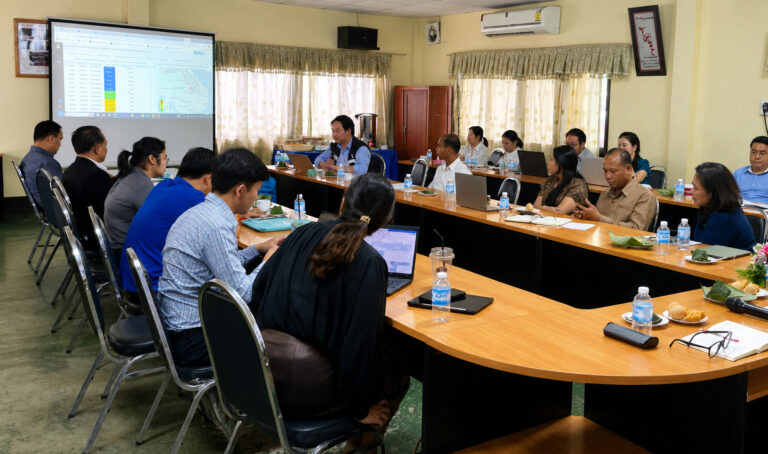
In August 2025, health officials in Xepon District noticed something unusual: malaria cases were rising faster than expected. Within 48 hours, provincial response teams had convened an emergency meeting, launched a field investigation to pinpoint the disease outbreak, and mobilized treatment supplies directly to affected villages.
Just a year earlier, that level of coordination would have been nearly impossible.
For years, Lao PDR relied on separate disease surveillance systems for malaria and other communicable diseases. Because the systems operated independently, health workers often faced delays in reporting, incomplete data entry, and limited coordination during outbreaks. Response teams lacked a unified view of emerging health threats, slowing decision-making at critical moments, and putting people’s lives at risk.
To address these gaps, PSI Laos and the Ministry of Health, with support from the Gates Foundation, worked together to strengthen the country’s public health emergency systems. The partnership introduced an integrated Public Health Emergency Operations Center (PHEOC) dashboard that combined malaria surveillance with broader communicable disease monitoring. We also expanded routine Incident Management Team meetings nationwide to improve coordination between national, provincial, and district health offices.
Almost immediately, outbreak information started moving faster and more reliably through the health system.
By 2025, health officials could monitor malaria trends, medical supply availability, and communicable disease alerts through a single platform. Provincial and district response teams were also operating with clearer protocols, stronger coordination mechanisms, and regular data review processes.
When malaria cases surged in Xepon, a coordinated detection and response system made the difference.
Using the integrated dashboard, response teams rapidly identified an unusual increase in Plasmodium vivax malaria cases and activated containment procedures. Field teams distributed rapid diagnostic tests, delivered malaria treatment to high-risk communities, and provided mosquito nets and repellents to reduce further transmission.
Compared to previous outbreak responses, teams responded approximately three days faster—a margin that can mean the difference between containing an outbreak or putting more lives at risk. All reported malaria cases were identified and managed according to outbreak containment protocols.
“We can respond more rapidly to outbreaks and ensure that support reaches affected areas promptly,” said Dr. Korlakhan, Head of the Communicable Disease Control Unit in the Savanakhet Province, “The effective response to the malaria outbreak in Xepon District demonstrated the value of improving preparedness and emergency response.”
Equally important, health workers reported greater confidence in using emergency operations systems and applying lessons learned through post-outbreak review sessions. The strengthened coordination between surveillance teams, logisticians, and district health offices demonstrated how integrated systems can translate data into action.
Lao PDR’s experience highlights the value of unified disease surveillance and coordinated emergency response systems in strengthening national preparedness. By investing in both technology and frontline capacity, PSI Laos and the Ministry of Health are helping build a more adaptive and resilient public health system—one prepared to respond to future health threats quickly and effectively.